Short Practice or Long Sessions for a New Skill?
Short practice or long sessions for a new skill? Compare focus, scheduling and chances to return so you can choose a rhythm that suits the work.
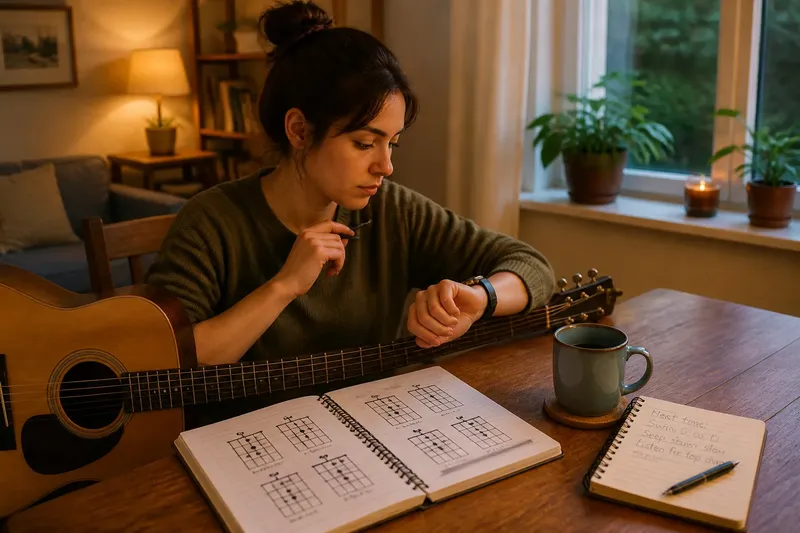
At the kitchen table, a beginner sets a guitar beside a mug, opens a chord chart, and checks the evening’s remaining time. The question of short practice or long sessions for a new skill is not abstract here: should the guitar come out for a brief daily visit, or for one longer appointment when the calendar allows?
Imagine that Maya, an invented beginner, wants to accompany a few songs on guitar. She has a household schedule that shifts from day to day, and she is not preparing for a fixed performance. Her situation makes a useful case because both practice rhythms are possible, but each asks something different of her attention and her opportunity to return.
What does the skill ask of each session?
Maya begins by separating the pieces of learning she is trying to fit together. She needs to recognize chord shapes, place her fingers, move between shapes, keep a steady strumming motion, and notice when the sound is unclear. These demands overlap, but they do not all require the same kind of concentration.
A short session can give one small problem a clear boundary. Maya might work only on placing her fingers for a chord, then listen for buzzing notes. A longer session gives her room to connect the parts: make the shape, change to another chord, keep the rhythm going, and recover when a transition falters.
This is why session length should follow the work rather than an appealing rule about how long practice ought to last. Repeating a simple movement may fit a brief visit. A task that involves setup, several linked actions, or a meaningful stretch of uninterrupted attention may need more room.
There is also a difference between doing more minutes and doing more learning. If Maya spends a long stretch repeating a transition while her fingers and attention become careless, the extra time may add little. If she stops just as she begins to understand how the transition works, a little more practice could help her use that insight.
How does attention change across the session?
Maya notices that her concentration is not the same every evening. After a demanding day, she can attend closely to one chord but loses track when she tries to strum and switch chords at once. On a quieter evening, she can stay with the combined task for longer without rushing through it.
A brief session can suit a narrow focus, especially when the learner has a definite question to answer. For Maya, that question might be: which finger is lifting too early? She can slow down, inspect the movement, and listen again instead of repeating the whole song while the source of the problem remains unclear.
A longer session is more useful when concentration can support a sequence rather than just a single detail. Once Maya can form each chord, she may need enough uninterrupted time to move between them repeatedly and keep a strumming pattern going. A single transition can feel manageable on its own while still disrupting the flow of a song.
Neither duration protects attention by itself. A long session can become fragmented by fatigue or distraction; several short visits can also be so rushed that Maya spends each one getting the guitar and materials ready. A useful test is whether she can still say what she is listening for and make a deliberate adjustment. When that intention fades, continuing on autopilot is less useful than pausing or changing the task.
When is there room to return?
Frequent practice has an advantage when Maya can return to the instrument without much friction. A guitar on a stand, a chord chart nearby, and a quiet corner make a brief visit easier to begin. Each return gives her a chance to recall the shape and notice whether the movement feels familiar, rather than treating every session as one uninterrupted block.
But a calendar full of tiny openings does not automatically make frequent practice a good fit. If Maya has to travel to a rehearsal room, arrange childcare, or set up unfamiliar equipment, a short visit may be mostly preparation. In that case, longer sessions may make better use of the effort it takes to begin.
Longer intervals between sessions bring a different consideration: Maya may need to spend part of the next visit remembering where she left off. A short note can reduce that reorientation. She could write, “Switch from G to D; keep the strum slow; listen for the top string.” That is more useful than a vague record that she practiced guitar.
The note does not replace returning to the material. It simply gives the next session a starting point, much as a bookmark keeps a reader from searching for the page. If the gap has been long enough for the movement to feel unfamiliar, Maya can begin with an easier version instead of assuming that yesterday’s fluency should still be there.
What does Maya’s trial reveal?
Imagine Maya tries a brief practice visit on evenings when she has little energy. She puts the guitar on her lap, works on one chord change at a comfortable pace, and writes down the next transition to revisit. The expected observable result is a clearer sense of which finger movement needs attention, along with a specific place to begin next time.
On a quieter evening, imagine she gives herself a longer session. She warms up with the familiar chord shapes, practices moving between them, then tries a short song passage without stopping after every change. The expected observable result is not a polished performance; it is a better view of whether the separate movements can hold together in sequence.
These imagined sessions do not establish that one schedule will work for everyone. They show how the same learner can use different lengths for different purposes. The brief visit isolates a detail and makes returning manageable. The longer one gives connected actions room to become a continuous task.
Maya can also learn from a session that goes poorly. If the longer practice becomes muddled, she can ask whether the task was too demanding, the timing unhelpful, or her attention already spent. If a brief visit feels like nothing more than setup, she can bundle that task with a second, related activity rather than treating shortness as a virtue in itself.
Which schedule fits this skill?
For Maya, the sensible choice is not a permanent contest between short and long sessions. She can use brief visits for focused work on chord placement or a troublesome transition, and reserve a longer stretch for linking those movements with rhythm and a song passage. The balance can change as the work changes.
Her decision can rest on a few practical questions:
- Is the task narrow? A single movement or detail may suit a brief session; a chain of actions may need more room.
- Can attention stay deliberate? If she is no longer listening or adjusting, she can pause, simplify the task, or return later.
- Does setup take substantial effort? If getting started occupies much of the available time, a longer visit may fit better.
- Will there be another chance to return? A realistic next opening matters more than an ideal schedule she cannot keep.
- Can she name the next action? A short note about what to resume can make a later session easier to enter.
These questions help Maya choose a rhythm without turning practice into a second job. They also leave room for ordinary variation. A day with more attention may support a connected run-through; a crowded day may still offer a worthwhile chance to revisit one detail.
What questions do learners ask about practice length?
Are short practice sessions enough for a new skill?
They can be enough for a focused task when the learner can begin promptly and work with attention. A brief session is less suited to a task that needs a long setup or several connected stages.
Should I practice every day?
Regular returns can help keep a skill present in daily life, but the right rhythm depends on the person, the skill, and available time. Choose a pattern that leaves room for attentive work rather than treating an unbroken calendar as the goal.
When should I choose a longer session?
Choose more time when the work involves linking separate actions, reviewing a broader passage, or getting through setup that makes a short visit impractical. Leave room to pause if concentration starts to thin.
How can I tell whether a session was useful?
Look for a concrete observation: a movement became clearer, a transition remained difficult, or the next task became easier to name. Feeling busy is not the same as knowing what changed in your understanding.
How can the rhythm change as learning develops?
As Maya becomes more familiar with chord shapes, she may spend less time inspecting each one and more time combining them. That change can make a longer session more useful for rhythm and song flow. Later, if one transition becomes awkward again, a brief return to that detail may be the better choice.
For anyone weighing short practice or long sessions for a new skill, the most useful question is what the next visit needs to accomplish. Match the time to the task, preserve enough attention to notice what is happening, and make returning easy enough that practice has somewhere to continue.
Maya’s guitar can stay on its stand with the chart open to the next passage. That small arrangement does not decide how long she should practice; it removes one needless decision, leaving her attention for the chord she wants to hear more clearly.