A Midweek Review for a Plan That Drifted
A midweek review helps you see what changed, keep the work that still matters, and choose one manageable adjustment for the days ahead.
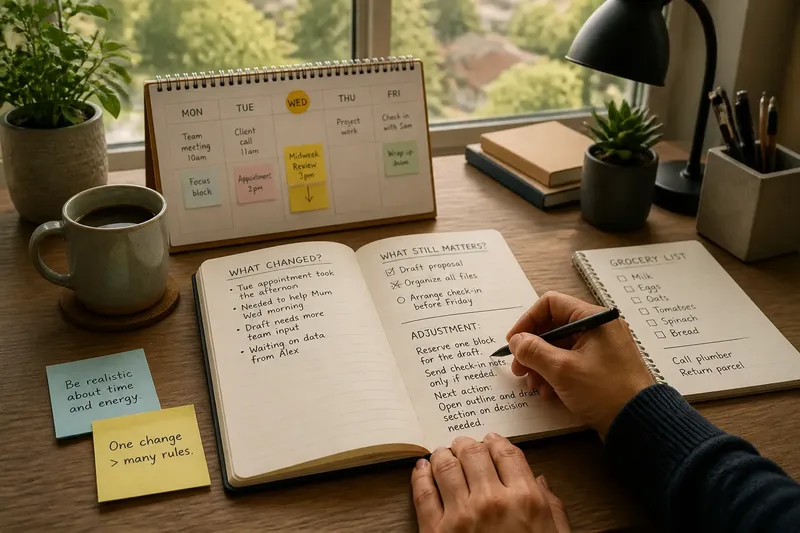
On Wednesday afternoon, a calendar reminder appears beside a half-finished document and a grocery list that has become a second to-do list. A midweek review for a plan that drifted is a way to pause in that ordinary moment, look at the days as they actually unfolded, and decide what deserves the remaining attention.
This is not a demand to recover every missed task. It is a small act of orientation: notice the conditions that changed, separate important work from stale expectations, and make one adjustment that fits the time and energy still available.
What changed after the week began?
Start with events, not verdicts. A meeting ran long, a family member needed help, a task proved more involved than it looked, or a quiet block of time never appeared. Naming the change plainly gives you something to respond to; calling yourself undisciplined does not.
Use a calendar, notebook, or the task list you already keep. Scan from the start of the week and mark only the moments that affected the plan. You are looking for a useful account, not a minute-by-minute reconstruction.
- Time: Which open blocks disappeared or shifted?
- Energy: When did concentration feel easier or harder than expected?
- Scope: Did a task turn out to include decisions, materials, or coordination you had not allowed for?
- Dependencies: Are you waiting for a reply, approval, or piece of information?
- New demands: What arrived that could not reasonably be ignored?
Keep observations concrete. “Tuesday’s appointment took the afternoon” is more useful than “the week got away from me.” The first note points to a changed condition; the second turns several different causes into one foggy complaint.
How do you tell a change from a judgment?
A review can easily become a courtroom: each missed item is evidence, and you are asked to explain yourself. Try treating it more like checking a kitchen drawer. If the tool you need is no longer there, the next question is where it went, not whether the drawer is a bad drawer.
Write down what happened in neutral language, then ask what it affected. “The draft needed another conversation with the team” may explain why writing time moved. “I am bad at planning” explains very little and is difficult to act on.
Neutral does not mean pretending the choices were all unavoidable. Perhaps you spent the planned work block on email because the next step felt unclear. That observation can lead to a practical adjustment: clarify the next action before the next block, rather than making a broader promise to focus harder.
Also distinguish a one-off disruption from a recurring condition. If the same kind of appointment regularly occupies a certain afternoon, it may belong in the plan as a normal constraint. You do not need to solve every recurring pattern during this review; simply noticing it can keep you from planning as though it were a surprise again.
Which commitments still matter?
Look at the remaining tasks one by one and ask whether each still serves a current purpose. Some work remains important even if its original timing has passed. Other items were useful only in the context of an earlier plan and can be removed without apology.
For each task, consider three things: what it contributes, what happens if it waits, and whether anyone else depends on it. A task connected to a promised handoff may deserve attention sooner than a personal improvement task with no near-term consequence. A task that no longer supports the goal can be crossed off, not merely carried forward to make the list look complete.
Say you planned to draft a short proposal, organize every reference file, and arrange a check-in before Friday. By Wednesday, a colleague has supplied the needed background, and the draft is still the piece that will let the group discuss the idea. You might keep the draft, drop the full file cleanup, and send a concise note proposing a check-in only if the draft raises questions.
The point is not that one task always matters more than another. It is that a plan should reflect present obligations and useful outcomes, rather than preserving every decision made before the week gave you new information.
How should you shrink the remaining plan?
Once you know what still matters, compare the remaining work with the actual spaces in your calendar. Do not count every unclaimed minute as usable time. Leave room for transitions, meals, messages, and the ordinary interruptions that make a tightly packed plan brittle.
Then choose one adjustment. It might be moving a task to a quieter block, reducing its scope, asking someone for a missing detail, or removing a lower-priority item. A single clear change is easier to remember than several new rules introduced in a moment of frustration.
Make the adjustment observable. “Work on the proposal” leaves the start uncertain. “Open the outline and draft the section describing the decision needed” gives you a visible next action. This is not a new finish line for its own sake; it is a way to make the remaining commitment easier to enter.
For the invented situation above, the adjustment could be to reserve one available block for the proposal and send the check-in note afterward only if the draft shows that discussion is needed. That choice protects the work that enables a decision while avoiding a cleanup task that no longer serves the immediate purpose.
If no suitable block remains, the honest adjustment may be to renegotiate a date or tell someone what can be delivered. A plan does not become more realistic by hiding the shortage from the people affected by it.
What should a midweek review answer?
How long should a midweek review take?
Keep it brief enough to finish before it becomes another project. A calendar scan, a few neutral notes, and one decision are often sufficient; extend the review only when a real dependency or significant choice needs attention.
What if nothing on the plan has been completed?
Start with the conditions and the smallest useful next action, rather than treating the empty list as a score. If the original tasks no longer fit, revise them; if one remains important, make its next action clear and place it where it can reasonably happen.
Should unfinished tasks move to next week?
Only move a task if it still has a purpose and a plausible place in the next plan. Otherwise, delete it, reduce it, or record what is blocking it so it does not quietly become a permanent resident on the list.
What if the same plan keeps drifting?
Look for a repeated condition such as an underestimated task, a recurring obligation, or a vague first action. Choose one adjustment to that condition and observe whether the plan becomes easier to use, rather than adding a larger set of rules all at once.
How can the review leave a useful note?
End with a short record that future-you can understand: what changed, what remains important, and what you chose to adjust. A few lines in the margin of a planner are enough. The note is not a performance report; it preserves the reasoning behind the revised plan.
Keep the language specific enough to help at the next review. “Unexpected work” is broad; “the client question needs a reply before the draft can move” identifies a dependency. “Try harder tomorrow” offers no direction; “ask for the missing decision before reserving writing time” gives the next plan something to account for.
It can also help to record what you deliberately removed. Without that note, a deleted task may return later as a vague sense of unfinished business. A brief reason—“not needed for this decision”—shows that the omission was considered, not forgotten.
There is no need to make the review resolve the whole week. Its useful contribution is smaller: a clearer account of what changed, a more honest choice about what still matters, and one manageable adjustment for the days ahead. When you make a midweek review part of your reflection, let the note be a handrail for the next decision, not another standard you have to meet.